
From One Boxed Miner to a Full Pallet
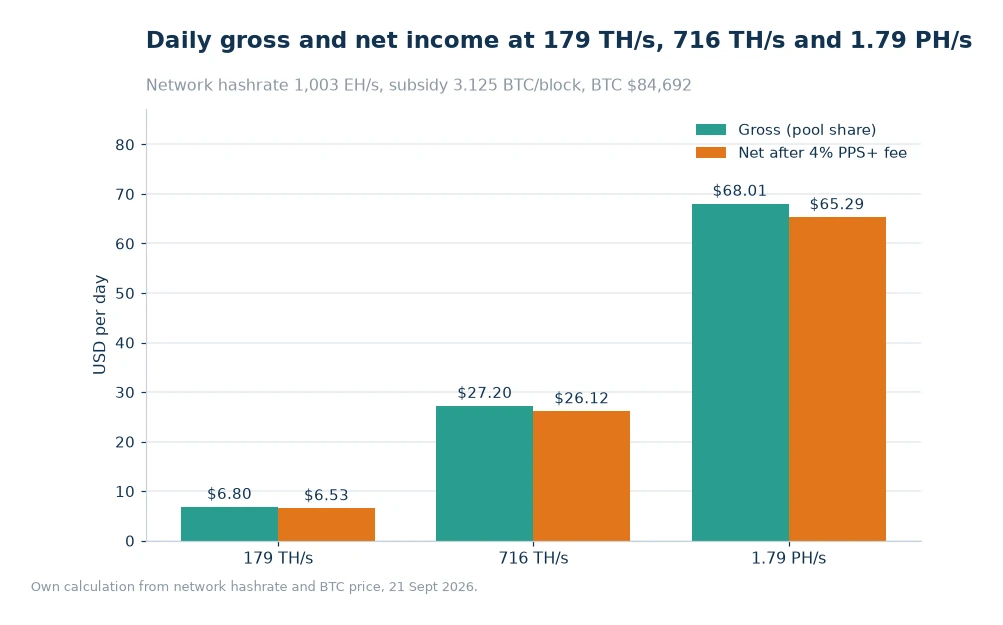
The first machine teaches a miner about noise. The tenth teaches them about circuits, heat and the difference between a hashrate total and a per-unit ledger. At 179 TH/s a single unit grosses $6.80 a day and nets $6.53 after the listed 4% on the block-reward component; ten of them gross $68.01. Everything between those two figures is arithmetic, and most of the operational difficulty lives in the parts that do not scale with the count.
Key takeaways
- 179 TH/s earns $6.80 a day gross and $6.53 net; 716 TH/s is four times that, and 1.79 PH/s is ten times.
- Income, pool fees and power scale with the machine count; breaker capacity, cooling and attention do not.
- At 22 J/TH and $0.05/kWh, a single unit leaves about $1.80 a day after power, and the margin improves per unit as fixed costs spread.
- Track each machine separately from day one, or a fleet average will hide a failing unit for months.
The first box and the fortieth are different projects
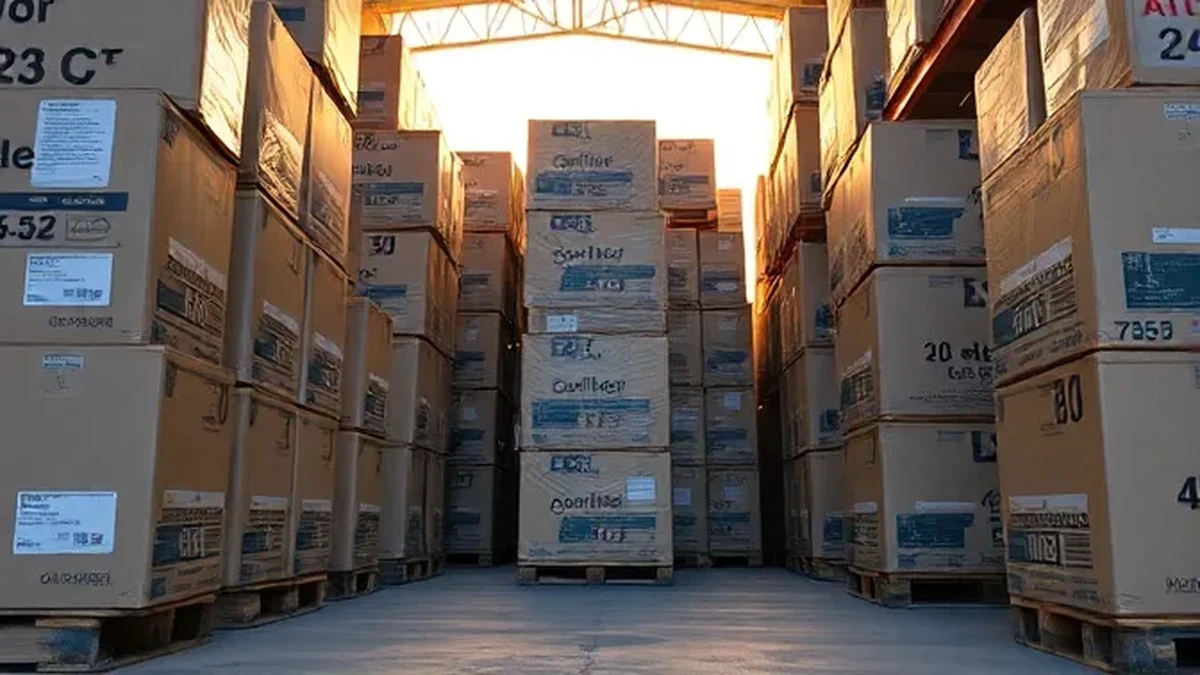
One miner plugs into a wall socket, connects to wifi and earns. A pallet of them needs a distribution board, a plan for 30 kW of heat, a switch with enough ports and a naming convention that survives a reboot. The mining arithmetic is unchanged; the physical layer is a construction project with its own budget and its own schedule.
That is worth saying plainly because the cost of the hardware is the visible expense and the infrastructure is the hidden one. Two operators can buy identical machines and end up with very different returns because one had a spare three-phase feed and the other paid an electrician to create one. Neither result is a mining story; both are ordinary capital planning.
What multiplies without argument
Income multiplies. A machine at 179 TH/s produces 0.0000803 BTC a day, and ten produce ten times that, because each contributes an independent share of the same daily issuance. The listed pool fee multiplies with it in the same proportion, so the net figure scales too: $6.53 becomes $65.29 at 1.79 PH/s. No economy of scale appears on this side of the ledger.
Power multiplies as well, and this is where the arithmetic becomes unforgiving. Ten machines at 22 J/TH draw 39.38 kW, or 945 kWh a day, which is a different class of electricity contract from a single 3.9 kW unit. The tariff per kilowatt-hour usually improves at that size, but the fixed charges and the demand charge arrive with it.
What refuses to multiply
Cooling does not scale linearly. A single unit in a cold room vents its heat harmlessly; forty units in the same room raise the intake temperature until the fans run at full speed and the boards throttle. The fix is airflow design rather than more fans, and it is much cheaper to plan before the pallet arrives than to retrofit after the first hot week.
Attention behaves the same way. One machine can be checked by looking at it. Forty machines need alerts, a naming scheme and a rule about what happens when one drops. A fleet without that structure is not forty machines; it is one machine and thirty-nine unknowns. A fleet run on ViaBTC Mining Pool keeps every worker on one screen, which is the starting point for any such rule.
Staging the arrival
Hardware rarely arrives all at once and rarely arrives ready. Unbox a batch, record serial numbers against worker names, run each unit for a day before adding the next batch, and keep the batches small enough that a fault is attributable. Adding forty machines in one afternoon produces a fleet that nobody can debug, because every symptom has forty possible sources.
Staging also spreads the capital. A first batch proves the power and cooling design at a tenth of the cost of getting it wrong at full size. If the room runs warm at four units, it will not improve at forty, and the discovery is cheaper at four.
The per-unit ledger
Every machine needs three numbers recorded weekly: hashrate, daily credit and power draw. The first two come from the pool account, the third from a meter or a smart plug. A unit that drifts on any of the three is a candidate for maintenance, and the drift is visible long before the unit fails outright.
Fleet averages are the enemy of this practice. A total that looks healthy can conceal one machine running at half rate and another compensating with a favorable efficiency. Sorting the ledger by daily credit per unit once a week costs a few minutes and catches the failures that a monthly total never shows.
Spares, downtime and the cost of waiting
A dead unit in a fleet is not just a repair bill; it is a missing daily credit. At 179 TH/s each idle machine costs $6.53 of net income a day, so a two-week wait for a replacement board is about $91 of foregone mining before the part is even paid for. Keep one spare fan and one spare power supply per ten machines, and the average outage shrinks to the time it takes to swap a component.
This is the part of scaling that experienced operators budget for and newcomers discover. The spare stock is capital sitting on a shelf, which feels wasteful until the first board fails on a Friday. Price it against a fortnight of lost credits and the shelf looks cheap.
Scale steps and what changes
The table follows the three tiers from the chart and adds the costs that appear with them. Power assumes 22 J/TH at $0.05/kWh, and the pool column uses the listed 4% on the block-reward component.
| Scale | Gross income | After listed fee | Power cost | Left over |
|---|---|---|---|---|
| 1.79 PH/s (ten units) | $68.01 | $65.29 | $47.26 | $18.04 |
| 716 TH/s (four units) | $27.20 | $26.12 | $18.90 | $7.21 |
| 179 TH/s (one unit) | $6.80 | $6.53 | $4.73 | $1.80 |
Worked example
Take one unit and multiply it carefully.
- Work out the base: 450 ÷ 1,003,000,000 = 0.00000044865 BTC for every terahash.
- 179 TH/s: 179 × 0.00000044865 = 0.0000803084 BTC a day.
- Gross dollars: 0.0000803084 × 84,692 = $6.8012, rounded to $6.80.
- After the listed 4%: 6.8012 × 0.96 = $6.5292, rounded to $6.53.
- Power: 179 × 22 J = 3,938 W; 3.938 kW × 24 = 94.51 kWh; × $0.05 = $4.7255.
- Left over per unit: 6.5292 − 4.7255 = $1.8037.
- Four units: $27.20 gross, $26.12 net, $18.902 power, $7.21 left.
- Ten units: $68.01 gross, $65.29 net, $47.256 power, $18.04 left.
Frequently asked questions
Does a bigger fleet earn more per machine?
No. Income per machine is fixed by its hashrate and the network, so ten units earn ten times one unit. Only the cost side can improve per machine, through cheaper power, shared infrastructure and better maintenance.
How much power does 179 TH/s need?
It depends on efficiency. At 22 J/TH the unit draws 3,938 W, or 94.51 kWh a day; at 30 J/TH it would draw 5,370 W and 128.9 kWh, which changes the daily margin considerably.
What is the first thing to fix when scaling up?
The electrical distribution and the airflow, in that order. Both determine how many machines can run at full rate, and both are far cheaper to design before the hardware arrives than to correct afterwards.
Build the ledger before the pallet
Set up worker names, a weekly per-unit table and an alert threshold before the second batch arrives. Then check the plan against the Profit Calculator at the fleet hashrate, and read the hosting options on Mining Farms if the building is the constraint rather than the machines. The per-unit ledger stays honest only if every worker is visible in one place, so the account structure deserves the same attention as the distribution board.
Network and price inputs, read 21 Sept 2026: 1,003 EH/s, 132.76 T difficulty, 3.125 BTC per block, $84,692 per BTC[1]. Published 24 Oct 2026. Power figures assume 22 J/TH and $0.05/kWh and exclude cooling and infrastructure.